introducing the customer-centric worldview from the GoodExperience Newsletter
colored table salt in 5 colors! via Jason at Kottke.org
forward into the past by Bill Buxton in the latest issue of the TIME magazine
Where the Best Ideas Take Wing Unsung ARS, one of the most innovative labs in the world, is doing some cool things with feathers again in the latest issue of the TIME magazine
Critical Mass book review on Innovation Watch
how to anticipate wrenching change by ChiefExecutive.net written by Leonard M. Fuld - EXTRACT follows -
Here are three ways to avoid being overwhelmed by inevitable change:
Learn to appreciate - and internalize - the fact that major changes in your industry are inevitable. Analyze potential changes on the basis of certainty and impact. For example, a group of senior managers at a certain health care company told me recently that of the many trends swirling about the pharmaceutical industry, the matter of whether new delivery technology will replace some of their company's therapies is both uncertain and potentially high impact to their business. This means it is worth watching but not necessarily acting on. This was exactly the position that executives at Kodak and Sun found themselves in-facing an uncertain yet potentially high-impact trend.
Use an early-warning system to create different futures, different worlds, in which your company may find itself. The best way to understand my point is to compare how a professional baseball game looks on a television screen, from a two-dimensional perspective that mostly shows a pitcher versus a batter, and then from the three-dimensional view of a box seat, where you can also see the coaches giving their signs, the fielders positioning themselves and the base runners taking their leads. Suddenly, the game becomes richer, and more complex. Most strategic plans envision a two-dimensional world, one obvious set of rivals governed by certain predetermined industry forces. But companies that use an early-warning system see the whole field, and make the necessary adjustments.
Identify legitimate but clear signals that will forewarn of change taking place. Early-warning scenarios don't just appear, they emerge relatively slowly. Executives learn to catch the signals by acting out scenarios, such as via carefully orchestrated war games, and thereby learn to appreciate the intensity of approaching tsunamis. In Kodak's case, silver prices and the early application of digital-imaging technology were all signals. RISC technology and open-source software were two signals indicating rapid change for Sun.
|
|
Tuesday, October 26, 2004
|
Adam Bostock at the if++ Innovation Forum by AcroLogic recently mailed me asking three questions. It was an interesting thought process and I am sharing my answers here. Would love to hear from you too!
What you find the most innovative and exciting developments in innovation?
One thing that immediately comes to my mind is systems like the IdeaAs in Action by SouthWest Airlines - very functional and usable implementation of a system which enables incremental as well as radical innovation from the employees themselves. These systems are few and far between and have not been replicated with 100% success.
Are the innovation consultants applying quantum leap innovation to their own field?
No, Innovation Consultants are not at all applying radical innovations to the field of innovation and creativity! I have been thinking on this myself! Very very interesting - if one of us develops an innovation for the innovators - it will be a great business opportunity!
What is the value of an idea?
The value of an idea - the originator, in most cases over values his/her idea an the person who has to approve it, in most cases, under values it! The value of an idea should not be determined only by the revenues it will bring to an individual or an organization, the value should alse be determined keeping in mind the implementability and acceptance value of the idea. An idea might be fabulous conceptually, but it might not be practical to implement - maybe because the requisite technology does not exist or is expensive - such ideas should not be completely trashed - they should be hung onto and when the techonology does become reachable - bang! the idea should be implemented!
So what do you think?
--What you find the most innovative and exciting developments in innovation?
--Are the innovation consultants applying quantum leap innovation to their own field?
--What is the value of an idea?
You are welcome to either leave a comment or e-mail me regarding this! |
The Innovation Game by Sara Driscoll talks about how " Innovation has no timeline or budget, and needs to be tested many times and in many different ways before anything innovative is ever produced. For true technological innovation this is true, but innovation within the channel is constrained by both budgets and time. This makes it no less innovative.
Innovation isn't necessarily discovering hyperthreading or the latest security standard, reinventing the internet or redesigning the microchip. Often the whole point of innovation is not simply to solve a problem, but to recognise exactly what the problem is in the first place. And it doesn't end there. Channel players who believe that solving a problem in a different way is the answer are only halfway there.
End-users often don't welcome innovation because it spells change, and because no matter how good a new system is, an old system will always have two advantages: it is established and it is understood.
It is the task of the channel to not only solve the problem, but to ensure end-users recognise why the innovation is needed. Buy-in is the essential ingredient to any real innovation, because without acceptance it will be stopped in its tracks." |
|
Saturday, October 23, 2004
|
Great post on IdeaFlow and a comment by moi! ?(Leaving intelligent comments is so tough! It's so much easier to just say "Hey! What a great post!") |
|
Bike, Mailing List and Innovation
|
Conference Bike - I would love to ride that! What a *kewl* idea! History of the creator and the Bike.
Magic or Myth? Innovation in Business. Article by the Institute for Emerging Issues. It starts with how important innovation is, goes on to give a short description and how innovation is important to firms. It then goes to give examples of the following firms:
-- Glen Raven "Celebrating 125 years of continuing innovation";
-- Apple "Live wirelessly for less";
--H.L. Patrick (i was unable to find a website - any clues?);
-- Toyota "Moving forward is knowing you're on your way";
-- Brayton International - it's a Steelcase company "Do what you do better";
-- Asheboro Elastics "The leader in elastics technology" (sad website! - but apparently change is on the way...);
Found a new mailing list for *innovation*. It is by EPA and I'm not sure what it's about. Have signed up and if it's interesting will let you know too. If you are interested in finding out for yourself, visit the mailing list webpage - EPA Innovation Mailing List.
Ahh! Just got the confirmation for the mailing list - this is what its says " This listserver is provided by EPA's Office of Policy, Economics, and Innovation (OPEI) to share information about innovations in environmental programs. It highlights innovations described in recent EPA press releases and provides a web link if available for obtaining more information. It also describes new reports, events, and other developments relevant to environmental innovation. This is part of EPA's continuing effort to improve public access to critical information." |
For sometime now I have been contemplating what to do - for the cause of Innovation. I have a community space on ORKUT for Innovation and there too the forum members have been contemplating "What about Innovation do we want to know?" The Google search for innovation gives a result of 13,500,000 page hits. But what is it about innovation that we would specifically like to know? It's impossible to sift through all those pages to get what we are looking for. Even if we classify our search with other words to narrow down the page hits, we might miss some really useful stuff and might get other stuff, which is not at all useful to us.
I personally want to learn more about implementing innovation within organizations. How have innovation consultants and others helped organizations become more innovative? How have organizations coped with the more innovative culture? What systems/processes have been used?
Apart from the search on Google, I have recently been thinking of doing a search on my Desktop! (using google's desktop search ofcourse!) I have a large number of articles, news stories, white papers, etc. stored on my hard disk and would prefer to first explore and discuss those rather than search around on Google.
If I do hear from you about what it is about innovation that you wan to know about, then we can have a themed discussion here where I could post relevant excerpts from relevant articles. So what do you want to know about innovation? |
Oh well! Another re-design! I have finally settled with this design - but I do not want to *say it too soon*! I also did our Corporate Branding for ASIDE and now ASIDE finally has a logo and I have also designed the business cards and you can take a look at them on my flickr account which is at http://www.flickr.com/photos/naina/. The cards and the logo have been optimized for the web as well as for printing and I'm all set to go! Click on the pictures for the photos on Flickr.
Front of Card

| Back of Card

|
|
I recently listed my company ASIDE on Morgle. Morgle got the e-Innovation Award from BBC for 2003. Although the service does fulfill its promise of *secure* communication, I have a feeling that for that security, communication itself loses out. One because it's slower and two because it somehow gives an impression of so much privacy that it almost seems that the listed companies would want to keep customers at bay instead of attracting them. For instance you could try e-mailing me from Morgle. It's quite interesting though. You could try it - listing your company on Morgle is free! |
The Applied Imagination Blog by the Creative Problem Solving Institute - *The Creative Education Foundation - the voice for Applied Imagination and producer of the annual Creative Problem Solving Institute - presents ideas about creativity, creative thinking, creative problem solving, innovation, imagination, and creative studies*
URL: http://appliedimagination.blogspot.com/
Thanks Chuck at the InnovationTools Weblog!
|
|
Thursday, October 21, 2004
|
These are some of the newsletters related to Innovation that I subscribe to and *read*! My personal favorites are Report 103 by Jeffrey Baumgartner, the Innovation Update by Innovaro, Innovation Tools by Chuck Frey and Goodmorning Thinkers by Joyce! If any of you is interested in any of these newsletters, first take a look at the website and then if so inclined, sign up and tell me which ones you like! Maybe I'll find a new innovation resource in the process!
|
Having my * case* published on the LinkedIn website was eye-opening in more than one ways. They really are thorough with their *success stories* - I got a call from one of their representatives all the way from San Francisco, USA and I am currently sitting in sunny village Abohar, Punjab, India. I had submitted my small story on their * Share Your Success* link and they promptly reverted - the written document went through 3 iterations before it was accepted. They did not change anything! (except some grammar!) This gives me enough reason to believe that all other success stories are *real* - which is quite a revelation because advertising/marketing is more and more *fake* and farther from reality and this was a real eye-opener.
I am happy with whatever I have learnt and whoever I have met on LinkedIn and hope to have many more fruitful interactions in the future! If you are on LinkedIn and would like to connect, do drop me an e-mail.
View the other LinkedIn case studies here. |
|
Wednesday, October 20, 2004
|
|
What's The Big Adventure?
|
"If the big adventure in the 15th century was to go to America, if the big adventure in the 18th century was to open a cotton factory, if the big adventure in the 20th century was to go to the moon, what's the big creative adventure in the 21st century?" -- Oxford philosopher Dr. Theodore Zeldin
This from the Creative Forum by the UK based Design Council. Link to the full article here. |
|
Thursday, October 14, 2004
|
|
Who is an Innovation Consultant?
|
Since I am one - and am busying myself in being an *expert* Innovation Consultant - I'd better know the answer to this one! But fact is I do not - well definitely not as a definition at least. I couldn't put it down in one sentence just yet...
Well one could say "someone who helps an organization be more innovative", but isn't that too vague? Afterall, in any good organization, a majority of the employees/management try to promote innovation right? I said *good* organizations...(now I am not going to get into the definition of a good organization, I'm trying to define an Innovation Consultant...good organization some other day).
So do I go about defining Innovation Consultant like I usually try and define everything else? Pull it apart and then build - analysis and synthesis? Like first define *innovation* and then define *consultant* and then put them together... it would work actually...
An Innovation Consultant would be a professional who:
1. helps an organization to determine whether it needs innovation
2. helps an organization to determine that if it does need innovation, is it *ready* for it
3. if the organization is not ready for it, then the innovation consultant helps the organization to get ready for innovation by conducting workshops, awareness councils, etc to increase awareness about innovation/change management
4. when the organization is ready for innovation, the innovation consultant creates buy-in from employees and the whole of management for the changes required by apprising them of the benefits/obstacles and planning for the same
5. when buy-in has been achieved and the whole organization is prepared for the next step, the innovation consultant devises programs/workshops to increase the innovative spirit within the organization - this is not just one step, it would, for example, involve devising an idea management system and implementing it, providing tools for increasing innovativeness within the organization, provide training for these tools and systems, etc.
6. once the training/implementation has been done, the innovation consultant works with the organization for an interim period to actually use those tools/systems and approaches in daily work life
7. after the interim period, the innovation consultant leaves the client organization - but not completely - the innovation consultant needs to keep checking back - at the behest of the client - whether the implmentation is yielding the results as hoped
8. if not, the innovation consultant is called back to determine obstacles and either improve the current system or implement a new one depending on the audit results (audit of the past implementation and working process)
I guess that's it. It's not a never-ending process, but every organization - or for that matter any human being - takes time to adapt to changes. The Innovation consultant is not only a catalyst, but also the implementer, the visualizer, the change manager, the interface between management and employees, a *business person* as he/she needs to be aware of the impact of the tools/systems, a forecaster since the innovative ideas and suggestions need to bear fruit, a mentor and some more.
Maybe there is no definition! What do you think? |
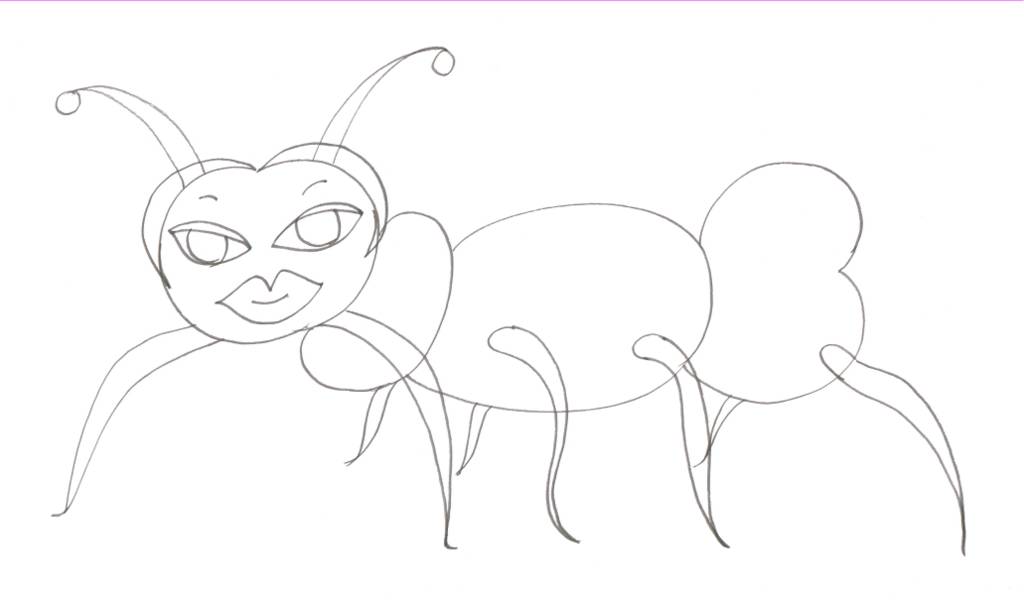
In the last post where I posted the two ant pictures... I said that I crumpled two of my sketches beacuse they "didn't look the way I wanted them to". The moment I wrote that I knew the subject of my next post (i.e. this one).
Isn't one of the reasons innovation does not flourish that we throw away what we don't like? Since the stuff we don't like is usually:
1. stuff we don't understand - what is that?! - how could you come up with something like that? - it doesn't make sense at all!
2. stuff we have never seen/heard of earlier - Whoa! Who does that?!
3. stuff that takes us out of our comfort zone
4. stuff that doesn't make sense - because we don't understand
5. stuff that had failed earlier - well maybe the circumstances were different earlier - and since it did not work earlier the organization/individual would be aware of the mistakes made in the first attempt - all the more reason to avoid those mistakes and give it another shot
6. stuff that doesn't fit in with company policy/personaly policy - again because it's out of the comfort zone
Ok, I'm beginning to repeat...
But you get the idea...so in order to allow innovation to flourish, we need to do the opposite of the factors that inhibit innovation...
Well I just uncrumpled the two sketches I threw and who knows - if I edit them well in Photoshop, I just might have a masterpeice! Radical innovation... What say? |
|
Wednesday, October 13, 2004
|
| Loads of handmade sketches - a sketching spree today! I did 14 sketches today - actually just line drawings - exploring shapes and curves. Crumpled two of them and threw them - they didn't quite look like what I wanted them to. The drawings are posted on Design Day and as and when I do the Photoshop runs, I will post the original and the Photoshop edited images on Design Day as well as announce them here. |  |  |
|
|
Tuesday, October 12, 2004
|
| New cartoon posted on DesignDay. First time I have tried to do a real skin tone - I had no idea how to do the shades and this is the first attempt. Maybe now I can graduate to doing more complex work - like full figure people - but GAWD! I had no idea it gets so complex! Maybe I should check a Photoshop tutorial...there just might be a better technique! |
 |
|
New graphic posted on DesignDay - designday.blogspot.com
It represents the elements - made a sketch on paper after a long time! Converted and edited in Photoshop. Both the original sketch and the edited graphic have been posted. Here is a small pic of what it looks like. |  |
|
|
Saturday, October 09, 2004
|
Just yesterday I had to show a "large" drawing to someone on the web. If I posted the drawing on this blog, the complete design would have gone "wonky". If I had posted it on the other design blog (asidedesigns.blogspot.com) that too would have lost it's design stability. So I had to create another - absolutely new blog at designday.blogspot.com - just for that new drawing.
I wanted to purchase the domain name www.aside.com but alas the price tag is $3888, which translates to almost 2,00,000 Indian Rupees. So that is out of the question. (Unless ofcourse someone reads this and makes a donation - which again is a hope in hell..). But I am designing a fresh website,which will act as a "one-stop" place for all my work/assignments/projects till date. Now I need webspace for that... Anyone care to help? Monetary/actual webspace...
I'm really tired of having to update three places whenever there is "one" thing I need to show/tell. This blog itself has lost focus! When I happily proclaimed that I would now be putting up my design work on this blog, I did it simply because this blog gets more visitors than the design blog! But it just doesn't help my cause!
Help needed! And when it is up - th eblog will go back to being an "Innovation" blog!
|
This is me - done with Photoshop! It's fashioned like a sticker... |
|
Thursday, October 07, 2004
|
|
Tuesday, October 05, 2004
|
|
Jeff Hawkins - Innovation
|
Voices Of Innovation: Jeff Hawkins
Creator of the first PalmPilot PDA and Handspring smart phone and author of the book On Intelligence, about the human brain and intelligent machines.
QUESTIONS ASKED:
Let's talk about serial innovators. What's the secret to success?
And so what steps do you do? (for innovation success that is)
Can a company be a big innovator?
SUMMARY OF ANSWERS:
Jeff says that he doesn't know if there is a secret to success.
He says "Being a great innovator is like batting in baseball. If you're batting .300 or .350, you're doing pretty well. Most people, they never get a hit. I try to think very hard about what's ultimately going to happen."
Once the long-term vision is seen, then one has to get there - step-by-step. You can't just solve all the problems at once and bingo, you have an industry. No, you have to solve a whole bunch of those problems, and along the way you have to make money while you're doing it.
Companies don't innovate; people do. If you're going to innovate, you have to overcome problems. In a startup, you're going to have all these people telling you you're wrong. If you're at a big company, you're going to have all these people telling you you're wrong. It takes a lot of nerve and perseverance. You have to keep fighting the battles.
SOURCE: BusinessWeek, the Innovation Economy Series |
Inspiration is fine, but above all, innovation is really a management process.
This article stresses on the fact that getting an idea is fine - but what about putting it to work - in terms of - revenues, feasibility, etc.
It starts by giving the example of Edison - most people would cite Edison as the inventor of the lightbulb - truth is there were others - decades before Edison who had "invented" the lightbulb. But Edison gets the glory because Edison not only made a new and improved lightbulb, he also provided the means/channel for the masses to actually use the lightbulb- sockets, the whole electrical system. Afterall, what good is an invention if the people who make the market cannot afford it/use it. Basically, it means that Edison "managed" the innovation process unlike his predecessors.
The management of innovation isn't any easier today than it was during Edison's era. Maybe we can take a pointer from all those "self-help" books which proclaim that we have to make our own luck - I mean it is somewhat easy to get lucky once in a while - but the trick would be to repeat the performance! One quote from the article by Paul Saffo (research director at the think tank institute for the future) goes like this " Managing innovation means cultivating an environment where lightning can strike twice. It's extraordinarily difficult." Wow! some help there - as it is innovation is tough and then we get people who are supposed to be the experts telling us how "extraordinarily difficult" it is - maybe articles on innovation should be written in an "optimistic" tone.
The article then states some problems - why innovation is tough, why breakthroughs are tough - a lot of forces today conspire against innovative products getting to market. Small outfits that are often the most innovative get short shrift because buyers aren't sure they can deliver or even survive to keep supporting their products. Then there is the "innovator's dilemma". Another quote from Gerard M. Mooney, vice-president and director of corporate strategy at IBM (IBM ): " All big companies have trouble coming up with the Next Big Thing."
At my last workplace, we use to often cringe at the word "commoditization" - we had done a case study when we joined as rookies and since then the word "commoditization" used to bring back memories of "long hours". The article give the blame of slow or no innovation to "commodotization".
Serial innovation may prove to be the key skill of the Information Age. Another quote by John Seely Brown - " Serendipity is nice, but we can't leave this to happenstance. We just don't have the money any longer to screw around."
The good news is that crisis is the mother of innovation. Ah! Now that is fodder to chew on. Very interesting - not that I'm hearing it for the first time - but just the fact that "organized" crises/risk are so difficult to manufacture and everyone talks of them all the time - had I known how to organize crises periodically - I would have had my door beaten down by now!
Another nugget : " Thinking big is important, but sweating the details is just as critical to spurring continuous innovation."
Perhaps the most fundamental quality of innovative companies is that they never stop hammering away at problems and opportunities. They know that if they don't, someone else will hammer them. Another quote by John L. Hennessy, president of Stanford University and co-founder of chip designer MIPS Computer Systems (MIPS ): " It's better to shoot yourself in the foot than to allow somebody else to shoot you in some more vital part of the anatomy."
Increasingly, companies are rethinking where innovations come from. The best ideas aren't always inside corporate research and development labs - it's becoming crucial to knock down walls inside the company -- between research and manufacturing or marketing -- while at the same time reaching outside the company for ideas. But it's not easy to do. Another quote by Karl Ronn, vice-president of P&G's home-care division: " Innovation nowadays is more like improvisation in jazz than playing out a score that's already written."
The ultimate in innovation, though, is not merely to come up with new products and services. It's to create entirely new markets where none existed before -- and better yet, to provide something that changes the way we live and work. Innovation was never just about new gizmos and gadgets. But in a service economy, innovations more than ever must transcend objects.
A fundamental constant of innovation: Nothing stays constant. Contending with innovation's disruptive influence requires a "culture of divine discontent" in which everyone itches to improve things. Most people, unleashed, are innovators. Humans are this great species of tool-using animal who like to make our world better. The companies that can unleash that particular animal instinct are the ones that will thrive.
SOURCE: BusinessWeek - the Innovation Economy Series. By Robert D. Hof with Peter Burrows, in San Mateo, Calif., Steve Hamm and Diane Brady in New York, and Ian Rowley in Tokyo
|
I now know how to use the PEN tool in Photoshop!
Here's what I made for the first time - using the pen tool that is! 
Next stop - portraits - using the pen tool! |
|
how to sharpen the innovation edge
|
This article appears in BusinessWeek as part of the " Innovation Economy", authored by Michael J. Mandel. The title of the article is " How To Sharpen The Innovation Edge".
The article starts by saying that although over the past 75 years, economists have learnt and lectured much about the world's economy, there is little consensus about what to do to "encouraging innovation". Views of some economists: cutting nation's budget for more funds for private-sector research, slashing taxes to encourage entrepreneurs, strengthening patent and copyright laws and also the view that too much protection of intellectual property will slow innovation - by increasing litigation, that is.
The article goes on to say why this is so tough - the innovation economy is dynamic and consists of a host of variables - government, universities, corporations, start-ups, VC's, etc. and to top it all - all have separate roles. Besides, innovation is no longer restricted - it's global...although I still haven't quite figured out what that means - innovation going global?
And then again - as most articles do - since most are written by Americans anyway - the articles goes on to say that (and I quote) "There is one guidepost amid the confusing trends: the enormous and surprising success of the American innovation machine in recent years." I would have loved to bite this down - unfortunately it is quite true - besides America and Americans also have money to sound out the whole world about their achievements - for a country like India, sounding out our achievements is like a middle-class family wondering on what paper to print the marriage cards.
The article then goes on to give some ideas on spurring innovation, which are:
- INVEST IN RESEARCH AND EDUCATION
- GET THE MAXIMUM BENEFIT FROM GLOBAL INNOVATION
- SUPPORT THE PATENT OFFICE
- BETTER NUMBERS ON INNOVATION (to say that innovation will be promoted when the case is supported with real numbers - which indirectly means that it requires systems to be transparent I suppose and that itself is a great problem for a consultant to solve!)
- MAINTAIN FREE MARKETS
The points above are described with various characteristics of innovation, which make the above steps necessary - for example - for the first point - "INVEST IN RESEARCH AND EDUCATION", the article builds its case thus: "Innovation depends on good ideas and smart people. So, to encourage innovation over the long run, the best course is to increase government funding for basic research, which is not profitable for most companies, and to spend more on graduate education in science and engineering." ...an example from the US follows, citing the "reasonably good record" of the US in these areas... Frankly, the article does make a good case for investing in research and education - atleast for the US.
Ah! Then the article mentions the "innovation becoming global" bit - apparently what it means is that innovation is spreading from a few large industrial countries to a broader stage. What is now needed to encourage innovation further is collaborative research without boundaries and to make use of innovations elsewhere (again that made me clueless - elsewhere? - and I'm not sure I got the "innovation becoming global" bit either).
More from this issue of BusinessWeek about the Innovation Economy as I read through it myself - later in the blog!
|
|
Saturday, October 02, 2004
|
The end of innovation?
If the U.S. doesn't invest more in the R of electronics R&D, the impact on the industry may be devastating. Read the complete article on the website.
SOURCE: Electronic Business
|
|
don't let anything stand in the way of innovation
|
SOURCE: The Globe and Mail
The article by Heather Bordo, who is an executive coach, consultant and strategist based in Toronto starts by saying that " Innovation is risky". The article says that innovation involves a shift from the "tried and so far considered 'true'" and an approach which basically is "comfortable".
Everyone talks of innovation as a necessary competitive differentiator - but there are various factors which discourage innovation to be embraced as actively as it is talked about.
Since what one has been doing for a long time creates a comfort-zone, it is difficult to actively think differently. Our assumptions tend to be "the same". The longer someone stays at an organization, the feeling of "been there done that" lingers and acts as an obstacle to innovation.
Also, it has long been known that compensation drives behavior - leaders who have spent their complete career in one industry or organization may not have reference points for innovative approaches. The article says that leaders who are measured on adopting innovation will be much more likely to support new approaches than leaders who are not.
Last but not the least, people generally are averse to change and are especially reluctant to try it in times of crisis.
The article ends by saying " Introduce innovative thinking tools such as brainstorming sessions throughout the organization. Get people comfortable with a broad range of such tools through training and participation in facilitated sessions. Incorporate tools to stimulate innovation in strategic planning, problem-solving sessions, strategic account planning and other operational processes. When innovation is encouraged and its perceived risks are minimized, who knows what great ideas will emerge."
Interesting read - easy on the brain - less jargon and good flow of thought.
|
At P&G, It's "360-Degree Innovation"
Chief Tech Officer Gilbert Cloyd on how the consumer-goods giant moves technology and ideas both internally and externally.
Questions asked at the interview:
- How has the way Procter & Gamble innovates changed in recent years?
- What changes in society and industry are altering the way P&G innovates?
- How does the innovation process work today at P&G?
- Can you give me some examples of how you cross-fertilize internally?
- How do you make those connections happen in a way that doesn't slow things down from all the coordination that's necessary?
- How does the company reach outside for talent and ideas?
- How well has it worked?
- Is the decline in corporate R&D spending a problem?
- These changes must be hard for people at P&G to contend with. How do you get them to go along?
- Why is it often so difficult for large, established companies to innovate?
- How do you get past those tendencies?
Answers to these questions include the following comments:
- more emphasis to what we call the desired consumer experience
- industrial design much more integrated into the innovation process than we had in the past
- putting a lot more attention on what we call 360-degree innovation - putting commercial and technical groups closer
- broader base of consumers
- more attention on the cost aspects of products - cost innovation
- facing an ever-faster pace of innovation in consumer-product markets; the pace of innovation has roughly doubled in the past 10 years; now innovations in the marketplace have a much shorter market life than previously; move to upgrade our brands even more frequently
- challenge in innovation is to present ourselves well with a lot of different brands and do it affordably
- INNOVATION PROCESS AT P&G: broad program called "connect and develop." In the academic world, it's called "open innovation."; want to connect internally -- move technologies and ideas across our business units internally -- but also connect externally.
- internal intranet "Ask Me" feature, 21 communities of practice within R&D and global technology council
- technology entrepreneurs search for ideas and people
- "When you get really big brands that are generating a lot of profit and cash flow, there's a tendency to make changes very carefully. If you do something that your large consumer base doesn't like, it can be a very significant negative financial impact. You've got to be careful, or caution will freeze you in place. Second, if you've been on a particular conceptual and technology approach that's working, there's just this tendency that people have to keep working with what's successful."
- "It's important to set the right goals. Asking people to set their goals in a very conscious, formal process is important to see if the innovation pipeline matches what they want to deliver. The perversion you can get into is that you build an incentive system that causes people to keep trying to make something a success and invest behind it when they ought to just quit. Kill it off, take the learning, and recycle."
SOURCE: BusinessWeek - for the complete article
|
|
BusinessWeek: the innovation economy
|
BusinessWeek's latest issue is titled: The Innovation Economy and the various article titles are as follows:
PHOTO ESSAYS
VOICES OF INNOVATION
- Steve Jobs - Chairman and CEO of Apple Computer and Pixar Animation Studios
- Cherry Murray - Senior vice-president of physical sciences research and a veteran at Lucent Technologies' Bell Labs
- Shirley Ann Jackson - President of the American Association for the Advancement of Science and president of Rensselaer Polytechnic Institute since 1999
- Wallace Broecker - A professor at Columbia University's Lamont-Doherty Earth Observatory and a leading researcher on the issue of global climate change
- Craig Venter - A pioneer in decoding the genomes of everything from microbes to humans, and president of The Center for the Advancement of Genomics
- Roger McNamee - An innovator in venture-capital investing and co-founder of the Silver Lake Partners and Elevation Partners funds
- Faqir Chand Kohli - Former chairman of Tata Consultancy Services, India's software outsourcing pioneer, and a champion of cracking the country's adult literacy problem
- Yuan Longping - Director general of China's National Hybrid Rice Research & Development Center and a pioneer in hybrid rice technology
- Tim Berners-Lee - The London-born inventor of the World Wide Web is now at Massachusetts Institute of Technology working to create the new "Semantic Web," a radical leap that would greatly improve how people and machines locate and use data on the Web
- Jeff Hawkins - Creator of the first PalmPilot PDA and Handspring smart phone and author of the book On Intelligence, about the human brain and intelligent machines
- Amory Lovins - CEO of the Rocky Mountain Institute, a nonprofit energy and environment policy think tank
OTHER ARTICLES
- This way to the future - from energy to biotech, we may be on the cusp of a new age of innovation
- Scouring the planet for brainiacs - worlwide innovation networks are the new keys to R&D vitality -- and competitiveness
- Flying high? - Long the innovation leader, the U.S. now has serious competition from abroad. Is America's research lead in danger?
- Nanotech: universe in a grain of sand - Scientists are finding that ultratiny materials behave in unexpected ways.
- Where our energy will come from - From seabed gas to pebble-bed nukes, a scouting report on tomorrow's sources.
- Aging is becoming so yesterday - Tantalizing new discoveries suggest the possibility of reengineering the body.
- Reinventing the wheels: fuel cells, crash-proof cars -- auto makers are forging the future now.
- In a tight spot: And Loving It - How Will TV Survive Its Own Reality Show? To thrive in the Internet Age, the industry must remake itself.
- An Old Hotbed With New Crops - This time around, the Valley is nurturing startups that combine info tech with emerging technologies.
- Getting The Best To The Masses - A wave of innovation is yielding high-quality goods that India's poor can afford.
- Huawei: More Than A Local Hero - The telecom gear maker aims to be a player in global innovation.
- The Old World Becomes A Little Newer - The trend toward collaborative innovation will help the Continent revive its R&D.
- Building An Idea Factory - Inspiration is fine, but above all, innovation is really a management process.
- Reaping The Wind - GE's energy initiative is a case study in innovation without borders
- Novel Inspiration - Otherworldly fantasies can evoke solutions to real problems. Science fiction has been honorably doing just that for decades
COMMENTARY
ONLINE EXTRAS
- Counting the femtoseconds - The Energy Dept.'s 20-year R&D plan aims to push the frontiers of fusion power, supercomputing, and nanotechnology
- Nanotech: Big concept on campus - Academia is fast becoming the center of this promising technology's universe, with states helping to pay the way a longevity company's first steps - Elixir Pharmaceuticals is still young, but its all-star team is aiming squarely at one of humanity's oldest dreams
- At P&G, It's "360-Degree Innovation" Chief Tech Officer Gilbert Cloyd on how the consumer-goods giant moves technology and ideas both internally and externally
- 15 Great Science Fiction Novels - Eric Rabkin's personal favorites
- Industry And Academia Weigh In (extended)IBM's Sam Palmisano and Georgia Tech's Wayne Clough talk about their National Innovation Initiative, due out in December
|
|
Graphic Published in 200by200
|
The 10th Issue of 200by200, the UK-based Design E-Magazine, published by Sean Makin carries a graphic designed by me on the theme of "Citylife". To download the 10th Issue, please visit www.twohundredby200.co.uk/downloadstore.html and right-click download the 10th Issue. It is a PDF file and you can see my contribution on page 76+77.
This is a smaller version of what the graphic looks like:

|
R&D teams need to spend time with customers if they really want to build new technology that sells.
SOURCE: InformationWeek
The article says that great technological innovation will only be successful if research and development teams understand the problems of a company's customers and have the right channels in place to get a new product to market quickly.
Comments from Paul Horn, IBM senior VP of IBM Research at the Emerging Technologies Conference:
"Innovation is not the same as invention--there's distinction."
"Innovation is not just great ideas but channels into the market."
"Success in R&D requires rapid flow of innovation into the marketplace. Time to market is critical."
"Exploratory work can survive, thrive in a world where there's a balance between short term and long term."
POINT: "get your researchers out in the real world and talk to customers [about innovations] that can change the world, not just their own little labs."
Paul Horn also says that standards are vital to innovation as well.
"Open standards, open source are critical for speedy innovation at a company, in an ecosystem, in the country."
The article ends by saying, "There's nothing worse than being slow."
|
|