|
Innovation and Business Edge
|
Question: What defines innovation, and what can I do to promote a culture of innovative thinking in my business?
Answer (Part 1 of 2): The Business Week article "Hot Growth Companies" (June 7, 2004) stated that "Building a sustainable enterprise requires speed, flexibility, innovation, and at least a little luck to thrive in the face of relentless competition." The dictionary definition of innovation is the process of making changes -- a new method, custom or device. However, all innovation is not the same. Fortune magazine, in advertising the Fortune Innovation Forum in November, says that "innovation is ideas in action. It's the origin of competitive advantage, the engine of economic growth, and the indispensable strategy for increasing market share and productivity."
Donna Prestwood and Paul Schumann, in "Applications of the InnoVantage Grid" (www.glocalvantage.com) describe nine different types of innovation and display them on a grid, with the Nature (focus) of the Innovation along one axis and the Class of Innovation (how great the change is from current production) on the other axis.
The Nature of Innovation falls into one of the following three categories:
Product innovations: involve the way things interact with things -- the function provided to customers or the form that function takes. Examples include improvement in industrial machinery, consumer goods, software and component parts.
Process innovations: involve the interaction of people with things -- the way a product is developed, produced and provided. Examples include improvements in manufacturing, distribution and development systems.
Procedure innovations: involve the way people interact with people -- the way in which products and processes are integrated into the operations of the enterprise. Examples include improvements in marketing methods, administrative methods, sales terms and conditions, and requirements generation.
The Class of Innovation falls into one of these three categories:
Incremental innovations: those that reflect a relatively small improvement over present products, processes, and procedures -- advances that are a little better, a little faster or a little cheaper.
Distinctive innovations: those that provide significant advances or improvements, though not ones based on fundamentally new technologies or approaches.
Breakthrough innovations: those that are based on fundamentally different technologies and approaches, and which allow the performance of functions that were previously not possible, or the performance of presently possible functions in a manner that is strikingly superior to the old. Prestwood and Schumann go on to say that "breakthrough innovation results in the creation of a new industry or class of technologies," which "result in a significant number of distinctive innovations, and, these, in turn, result in a flood of incremental innovations."
Source: OrlandoSentinel, here. (free registration required)
|
|
Innovation and Entrepreneurship
|
If you believe the hype, start-ups are an innovative breed that go against the grain of conventional business. But are they?
A new study says the vast majority are not, leading one to wonder whether innovation is what it takes to start companies, or if they're really fueled by something else. The findings, released this week in the Global Entrepreneurship Monitor, are part of an annual assessment of entrepreneurship as it relates to economic growth in more than 40 countries. Developed by Babson College, the London Business School and the Ewing Marion Kauffman Foundation of Kansas City, the survey contains lots of interesting facts -- Who knew Uganda ranked No. 1 in entrepreneurship? -- but those on innovation stand out.
The largest number of start-ups pursued less-than-innovative ideas in highly competitive industries. In the highly competitive U.S. market, 27 percent were pursuing an idea that was "not new to any customer." Start-ups considered most innovative -- pursuing an idea "new to all" in a market with "no competitors" -- amounted to only 4 percent of the total. Bill Bygrave, co-author of the study and a professor of entrepreneurship at Babson College, Wellesley, Massachusetts, called those innovators "superstars" but added that they were the rare exception.
"The grass-roots entrepreneurs are companies that take something someone has done before and do it better, or cheaper, or offer better service," he said. "That's the core of the economy." It's also because the landscape of entrepreneurship includes everyone from a fast-food franchise owner to a high-tech innovator. The advantage of the former -- no new product, many competitors -- is that the ubiquity of the idea shows it can work. The company will not face the task of having to convince customers to buy it. The downside, of course, is that the customer may not choose to buy it from this particular company, since so many others offer a similar product or service. One solution -- innovation -- is risky and costly, but small, incremental innovations can be highly profitable.
In line with these findings, venture capital tends to be a poor marker for start-up activity, because so much of the money backing new companies goes to less than earth-shattering ideas. Venture capitalists avoid early stage companies. The total amount invested by venture capitalists to seed new companies in 2002 was $304 million, the lowest since 1980.
Given this reality, Bygrave tells students to just do it -- get started in business, rather than spend a lot of time creating the ultimate concept that will very likely fail to win the attention of venture capitalists. All of which points to the conclusion one might glean from this study: Highly innovative ideas are rare, whereas modest ideas backed by friendly capital might very well be the root of a successful business, if not the economy.
Source: Reuters, here.
|
|
Creating an Innovation Mindset
|
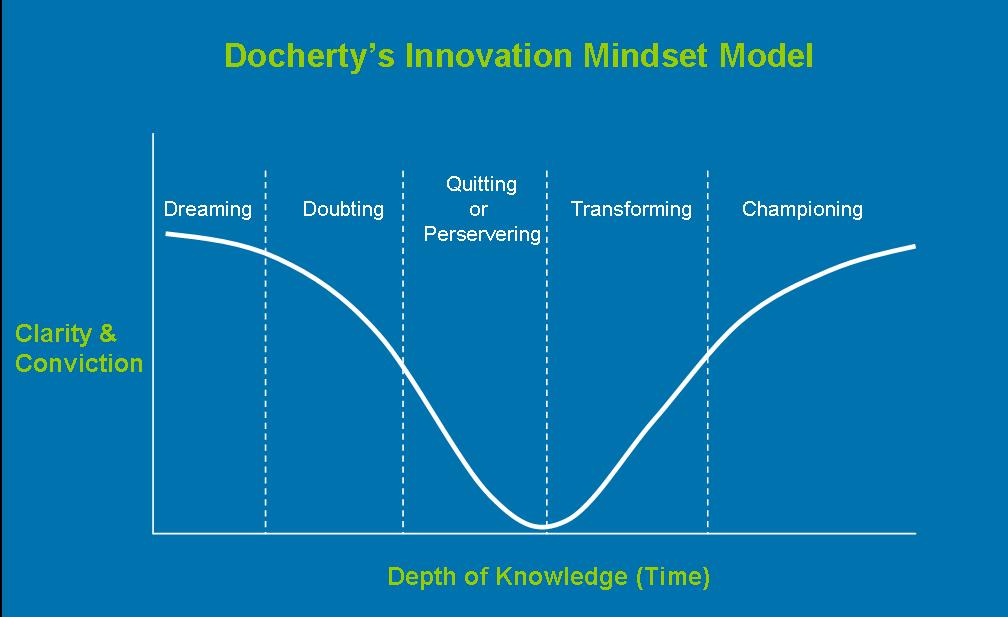
This Innovation Mindset Model is from the Innovation.Net Blog by Mike Docherty. I discovered the blog recently on BlogShares.
"At the beginning of any strategic innovation initiative, everyone's excited and optimistic, we've got a great idea and we're going to rule the world (Dreaming). Then $%^& happens as it always does and we face failure (Doubting). It's never as easy as we thought it would be. Failure is a natural and useful element of innovation... it's how we learn and adapt our solutions. Or determine it's time to try another challenge. As we develop innovative concepts into real-world practical solutions, we're learning more, the problem isn't as simple and we begin to truly understand the complexity of the challenge. It's this 3rd stage (Quitting or Perservering) that truly separates innovators from dreamers... those that perservere and don't quit often experience a transformational experience of having worked through the challenges and acquire a new confidence built upon deep knowledge and experience. "
|
The contemporary manager has a problem. It is no longer possible to touch or see the things that matter to business performance. A long-term shift from tangibles to intangibles is occurring in many industries. The focus is no longer mainly on cash, inventory, plant and equipment or land, which typically accounts for only about one-fifth of a firm's value.
Instead, more slippery considerations such as vision, motivation, various types of explicit and implicit knowledge, customer and employee loyalty, and brands are the key determinants of an enterprise's performance. In 1982, 60% of the value of the United States S&P 500 companies was accounted for by tangibles. By 1999, it had fallen to 16% (the figure remains below 20%). According to the consultancy firms Accenture and AssetEconomics, by mid-2003, $US7.6 trillion, or 58% of the value of the US stockmarket, was a valuation of the future potential of intangibles.
A 2003 survey by Accenture, AssetEconomics and the Economist Intelligence Unit of American companies found that half the executives listed the management of intangibles as one of their top three priorities. Yet only 5% said they had a robust system of measurement. One- third had no measurement in place, and 61% had measures that were either informal or unorganised. John Barton, principal of John Barton Associates, says companies have trouble developing the new ways of thinking required to understand and assess intangible assets. "What you see in company after company is that knowledge management is pushed back into IT."
What is required is not a modification of the methods used to value tangibles but a radical departure. Intangible assets are considered to be elements such as innovation, knowledge (explicit and tacit), governance, organisational design, reputation, customer and employee loyalty, capabilities and brand strength. The way in which these are bought, sold and created, is different from tangible assets. For one thing, intangibles have a more uncertain value than is usually the case with tangible assets. Investing in knowledge generation, for instance, can lead nowhere or it can lead to high- value returns. The result of an investment in plant and equipment, by contrast, is comparatively predictable.
Some intangibles have completely different characteristics from tangibles. Knowledge, for instance, is usually not scarce in the way tangible assets are (because it is not lost to the owner when sold). Possessing knowledge is to some extent inevitable in a business, whereas owning a tangible asset is not. It is hard to imagine a business without knowledge, at least if it is to have any hope of staying in existence. Businesses cannot "own" knowledge, except to the extent that they can legally protect its fruits through patents and brand names. The push from the accountancy community to take a pessimistic view of intangibles on the balance sheet is at least half right.
The "snapshot" approach to valuation (the balance sheet is a snapshot of a business's value at a moment in time) is not ideally suited to getting a grip on intangibles. What really matters is what income they will create, not what their resale value is (which means taking a close look at what customers will pay for in the future). For example, important staff members may create great value for an organisation, but they cannot be bought and sold in the way that, say, land can. Resale value is largely a meaningless measure for "human capital".
The greatest challenge is in human-resources management. The term itself inspires little confidence (humans are in no meaningful sense "resources"). Yet if intangibles are to be managed well, much depends on the way people are managed. All intangibles gain value only because of what people do. Peter Aughton, chief executive of the consultancy Amerin and director of the Fred Emery Institute, says human-resource managers might do well to drop the title. "Human-resource managers often come through a background of the humanities, but somehow they lose their roots and try to run things as a machine. They get lost in bureaucracies and … the reward structure." Barton says what is required is "360-degree stakeholder management" - not just training workers to be multi-skilled, but also to involve them in management. Without this, the necessary innovation and flexibility will not materialise.
One way to derive an assessment of intangibles is to use "future value analysis". According to an article by John J. Ballow, Robert J. Thomas and Goran Roos in the Journal of Applied Corporate Finance, this is the difference between a company's market capitalisation (the total value of its shares) and the "current value of daily operations". The general rule of thumb, they say, is that capitalised current operating value equals 10 times the current earnings.
Future value is only a tentative indication of a company's need to manage intangibles but, in combination with net tangible assets as a proportion of the share price, it does give an idea of a company's position. Ballow, Thomas and Roos write that no US companies include accounting for intangibles in their annual reports. Only in Europe have there been serious attempts to improve the accounting for intangibles.
Source: BRW Magazine, by David James
|
"We need to change the culture of this organisation!" Whenever I hear this war cry, I cringe. Culture cannot be imposed; it must be discovered. What is frequently overlooked is the fact that the culture of an organisation is contained in the hearts and minds of the people it employs. It is already there, waiting to be expressed. To the extent that we allow that culture to be expressed, a range of benefits will emerge. If we don't allow that culture to be expressed, an organisation will always fall far short of its potential.
I often ask employees to tell me what they expect of their employer. It is amazing how consistent the response is irrespective of the industry, from specialist medical practices to manufacturing. The first expectation is to be ethical. This is, of course, a term that has many shades, but in essence, what employees want is to be able to look customers in the eye and feel that they have done them a good service and that they give value for money. They don't want to cheat or do something that is shady or questionable. They want to be perceived as honest.
In a workshop that I conducted with a group of rookie executives at the University of California, Riverside, which consisted of people from Japan, South Korea, Denmark and Argentina, I received the same response. These people also said that what they expected in their work was:
- Open communication.
- Positive feedback.
- Management that would listen to them and respond to their input.
- Clear goals and an ability to verify them.
- To have fun.
Across Australia and worldwide, employees consistently tell me the same thing. What better culture can you have than people who want to be ethical, have input into how the business is operating, get positive feedback from management, be able to set goals and achieve them, and have fun while they are doing it? The overwhelming desire of most people in the workplace is to do good, to have fun and be proud of where they work. The challenge to management is to give free rein to these aspirations and let loose the culture that is bursting to be expressed. Unfortunately, a competing challenge is to report good quarterly figures. Letting the culture become established might not do too much in the first few quarters of the regime but the long-term sustainability of the organisation will be more secure and many more people will be happier going to work each day.
Source: BRW Magazine, by Louis Coutts
|
A recently launched site, patents | oncloud8, offers pre-stitched, batch downloaded US and international patent copies in PDF format at a very resonable $0.49 per patent. Unlike similar services, there is no software to install, no registration to fill and, best of all, no membership fee. Batch abstract lookups are available for free.
Great service - already lots of traffic - considering it's a recently launched service.
|
The innovation gap is still widening between Chinese manufacturers and their European and American peers. A most recent survey shows that 90 percent of European and American multinationals have made innovation a part of their strategy and 80 percent of them invest at least 10 percent of their profits into R&D activities. 55 percent of their innovations are the result of their cooperation with universities, research institutes and other enterprises.
But the story is different in Chinese enterprises which do not input much of their resources in R&D. Many small and medium sized ones do not even have any R&D. Statistics shows Chinese businesses hold one thirtieth of patents of that by Japanese and American companies. Many Chinese enterprises rely too much on imports of core technologies and equipment. Imported equipment costs more than 60 percent of China's input in equipment every year.
Recently, the Time Magazine in America published an article expressed concerns on the transfer of US manufacturing base to China. It also offered a solution: making US enterprises more innovative. The article recalled how innovation helped American manufacturers resist the challenge from Japanese competitors 20 years ago.
Ms. Panchak, editor-in-chief of Industry Week, pointed out that many manufacturers were worried about competition on prices because that was their weakest point. But their worries are caused by their little progress on innovation. Players with a futuristic vision can always find ways to offset price pressure with innovation.
Source: Peoples Daily Online, here.
|
- Do not let your first task of the day be to check your e-mail. Look at your calendar first to prepare for the day's events.
- Allocate specific times of the day to read e-mail, rather than doing it randomly.
- "Only handle an e-mail once," says IBM Australia's chief executive, Philip Bullock. "When you open it, decide whether you are going to deal with it, delegate it or delete it."
- Do not store outstanding e-mail in your inbox. They will build up too quickly. Deal with the e-mail straight away or put it on your "to do" list so you know what you have to follow up on and when.
- Do not just write "Re: Hello" in your e-mail heading. Be specific in the heading.
- Companies should question the use of distribution lists.
- Ask an information technology specialist to show you how to archive your e-mail.
- Be selective about who you "CC" your e-mail to. Most people do not need to see them, or even bother to read them. It is estimated that 70% of e-mails are CC'd unnecessarily.
- Set up a filter so that if your name is in the CC box, the e-mail is diverted to a subfolder that you can read at your leisure. Most CC e-mail does not require urgent attention.
- Instead of e-mailing someone, you can often save time by telephoning them. You can e-mail them afterwards to summarise your conversation.
- Take a short course in the software you are using.
- Discuss e-mail use and relevance with staff to reduce unnecessary e-mail.
- Be sparing with graphics and attachments.
- Regularly archive all your e-mail on a CD.
- Remember that e-mail does not make you a better communicator, just a faster one.
Source: CHRISTINA CAVANAGH / INDUSTRY CONSULTING SERVICES, SWINBURNE UNIVERSITY / IBM / FLIGHT CENTRE
|
Excerpted from the Harvard Business Review.
An idea is defined as radical if it meets one or more of these tests:
- It has changed customer expectations and behavior.
- It has changed the basis of competitive edge. (The proliferation of digital cameras is an example.)
- It has changed industry economics.
One way to come up with radical ideas is by deconstructing your business model and asking: "Is there no other way to organise our business?" Another is for staff to cultivate an empathy with the customer that is so strong that they can solve problems the customer can barely articulate.
Source: BRW Magazine by Amanda Gome
|
|
Art of Strategic Innovation
|
Article contributed by Paul Hobcraft.
The Art of Strategic Innovation
Excerpts from an interview with Costas Markides, Professor of Strategic and International Management, London Business School.
On defining what strategic innovation is: 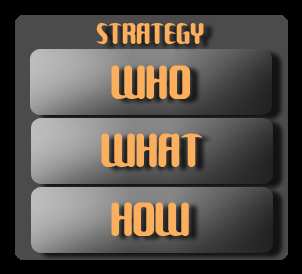
|
Strategic Innovation is the discovery of a new way of playing the game in your business, which is fundamentally different from the way most other competitors are playing the game. Strategy is finding answers to 3 interrelated questions:
i. who will I target as my customer
ii. what shall I offer to these customers
iii. how can I do this in an efficient way
Strategic innovation is the discovery of a new "who-what-how" position in the business - a position that all other competitors have missed. By discovery of this new position, we discover an untapped source of value in our industry. |
On how to recognize strategic innovation:
When a company suddenly starts to play the game in a totally different way from everyone else - they have strategically innovated.
On the radicalness of strategic innovation:
Strategic innovation is discovery of a new strategic position that allows the company to develop not only something new but also something large - something that captures a significant market segment. In any business there are niche players and they are, by definition, playing the game in a way different than the mass market. But if they remain small, no one pays much attention to them. However if a company discovers a niche, a new customer segment, a new delivery method, etc., and that niche actually grows to become 10%, 20%, 30% of the market, that is when people take
notice and say: Isn't that interesting, isn't that innovation?
The other element to the definition if strategic innovation is that it is a new positioning. Although there is no precise answer about the degree of "newness", one can generally tell when a company starts playing the game in a fundamentally different way.
On the question of "Who generally innovates?"
A list of strategic innovators mostly has new entrants or new business start-ups.
They will usually be entrepreneurial start-ups that, having identified a new positioning in the business, pursue it rigorously. It is very rare to find an established company strategiclaly innovating because they already have a positioning that enables them to make money - so why look for any other positioning? Another problme is the inertia of success. Well established, with a certain market share, profitable - why the hell should they change? Then there is also the problem of actually identifying a new positioning. A new entrant on the other hand starts with a clean slate and a fresh perspective, allowing him or her to identify a position that has not been taken yet.
On playing two totally different games:
The traditional economic argument made popular by Michael Porter is: a company should not try to play two games att he same time. Porter argues that there are too many conflicts in trying to play two games and as a result most companies that try are doomed to fail. He cites Continental Airlines as an example. Continental was playing the airline game the traditional way, based on the hub-and-spoke system. But they wanted to respond to Southwest who was playing a totally different game, the game of low cost, point to point direct flights. To play this game, Continental created a new subsidiary, called Continental Lite. Porter points out that the new subsidiary failed because there were conflicts in trying to play these two games.
What are these conflicts that Porter talks about?
• One such conflict is the risk of cannibalization. A company may lose existing
customers to the new game (which happens to be low-margin).
• Another is distribution conflict. Why doesn't IBM try to sell its computers direct? Well, how would IBM dealers feel if, all of a sudden, everyone could buy an IBM personal computer direct? Porter also argues that, in trying to play two games, a company may harm its reputation.
• And finally there is also the factor of organizational conflicts. If an organization follows a certain strategy it needs a certain culture, structure, incentives. If all of a sudden the company wants to follow a different strategy, it needs a very different culture, structure, incentives.
My own position is that Porter is wrong in advising companies not to play two different games. I agree with him that playing two games is really difficult given all these conflicts, but not impossible. Conflicts can be managed! Over the past year, I have been studying companies that seem to be able to play two games at the same time. One generalization we can make at this stage is that these organizations have found ways to overcome these conflicts. How? For example, they minimize cannibalization by
(a) creating a totally separate brand name for the new business and
(b) addressing a different customer segment.
For example, look at VW and Audi, British Airways and Go, Midland and First Direct, Swatch and Omega. All these companies are playing more than one game but they have different names for their products. Physical separation of the units also contributes to a reduction of conflicts.
On strategic and technological innovation:
Strategic innovation happens in the absence of technological innovation, it is different from technological innovation. Strategic innovators don't discover a new product or a new technology; they just find a new way of playing the game in the existing business. But we can learn much about strategic innovation by looking at the literature on technological innovation, for example, the importance of separating the old and the new. Research tells us that if a company is to succeed in promoting a new, different technology it has to set out a separate unit to promote this new technology. It cannot do it internally; it cannot do it with the existing organization. The existing status quo will suffocate the new technology and the
new unit.
On how to innovate - strategically:
There is, obviously, no correct way to go about it. There are a variety of tactics a company can use to improve the probability of coming up with new strategic ideas.
One is to fundamentally question the existing mental models and the existing unquestioned assumptions of the organization. Every organization operates under certain mental models, paradigms, assumptions: these are our customers, this is how we sell and this is how we do business. My proposition is that an organization will never discover anything new unless it first questions what it already has and says: why are we doing it like this, could there be another way? As long as they are happy and satisfied with what they have, they are not going to search for something new - and will never discover anything new as a result.
The first step in this voyage of discovery should be to question what you have.
Now, having said that let me also say that most companies, on a rational basis, say: "Yes, that sounds good, we will question", but they never do it.
On why they don't do it:
The primary reason is that we are all very busy people. As a result we set priorities in life and we say, first we do number one and then number two, then number three and we go through the list of priorities and do whatever time allows us. Now there is also the demand to innovate and we agree that it is important. But even though it is important and we want to do it, we believe that there are many more important things in an organization to be done. As a result we do these more important things and by the time we come to the just important ones, we have run out of time and we never do it. Unfortunately innovation is important but not urgent. And as a result it stays in the middle of the bottom of the list and we never find time to do it. In my experience, for an organization to encourage the honest questioning to take place, it has to create a positive crisis. It has to create some
kind of shock.
On how to achieve positive crisis:
First, you have to develop a new challenge, a new stretching goal for the people. But that is the easy part; it is only 1% of the work. The other part of creating a positive challenge, which is by far the more important, is to sell this new challenge to your people. It is not enough to create a stretching goal, it is not enough to create a mission statement that states 'I want to be number one' or 'I want to be the best'. You have to sell it to your people so that they become true believers in that new objective, that stretching goal.
If it really is a stretching goal, the first reaction of your people should
be: "my god, that's impossible, we can never do that!" But that implies that
you have to focus all your energy on the next task: to convince people that this
new stretching goal is meaningful and that it is important to them.
At the end of this selling process you should find people who are enthusiastic, and
energetic, and passionate about what the company is trying to achieve. However, it is not easy and it is very time consuming - but the selling is the most important part of the job of any top management team. If you just create a stretching goal and fail to sell it, all you will have created in your organization is de-motivation, cynicism, sarcasm.
On the four step process:

|
-- COMMUNICATION: Develop the stretching goal and communicate it to people tell them what it is. But mere knowledge does not create passion.
-- EXPLANATION: Explain why it is important. Why is it important to them, why is it important to the organization? But neither does explanation create passion. The first reaction should be "this is impossible."
-- MAKE IT BELIEVABLE: One way to make it believable is through the creation of early victories. It is success that slowly turns people around and they start saying "maybe, afterall, we can do this!"
-- EMOTIONAL COMMITMENT: Transform it from a rational to an emotional process. With the first three steps you have told them what it is and convinced them that it is important and that they can achieve it. All you have done is to win their minds. But what you want to do is win their mind and their hearts. To achieve this final step of winning their emotional commitment you can use a variety of tactics:
-- Make them feel very special
-- Reinforce the feeling of uniqueness by being very selective on who is invited into the team
-- Enforce the feeling of being part of a special team by creating symbols for the team.
-- Allow them to participate in the creation of the objective
-- Empower them to go out and do things to achieve the objective
-- Create a credible enemy for them |
On the greatest obstacle to strategic innovation:
The greatest obstacles in my mind are our own mental models, the unquestioned assumptions, the stereotypes and beliefs that we individually and as organizations, have. They don't have to be explicit, they don't have to be written down but they are there nevertheless. They are like our genes, they control our behavior and we don't even know that they do so. Every organization has a lot of sacred cows which they are unwilling to bring to the surface and question. And these sacred cows condition what an organization does, what the people in the organization do. The first thing we need to do is to question these sacred cows. These sacred cows have to be brought out, questioned and sacrificed before anybody can come up with any new ideas. |
|
Source: Business Journal, here.
Fear is the biggest obstacle to Americans embracing innovation, according to a preliminary report issued Friday by the National Innovation Initiative. Other obstacles include
-- inadequate infrastructure,
-- talent and
-- skills as well as
-- how resources are invested and used, according to the report.
Americans must resist "impulses to become centralized, inward-focused or risk-averse," the report states. "We know that we can't preserve our way of life or generate new jobs or win the war on terror or lead the world by playing defense."
|
|
Cultural Norms for Innovation
|
Bearing in mind that external context heavily impacts innovation and reciprocally, the intrinsic creativity inherent in the organization defines its ability to adapt to and even shape the environment, we can ask how culture can promote innovation. Does culture hinder or enhance the process of creativity and innovation? The answer is that it simply depends on the norms that are widely held by the organization. If the right type of norms are held and are widely shared then culture can activate creativity. If the wrong culture exists, no matter the effort and good intention of individual trying to promote innovation, few ideas are likely to be forthcoming.
Norms that promote innovation:
Challenge and belief in action
-- No obsession with precision
-- Emphasis on results
-- meet your commitments
-- Anxiety about timeliness
-- Value "getting things done"
-- Hard work is expected and appreciated
-- Eagerness to get things done
-- cut through bureaucracy | | Freedom and risk-taking
-- Freedom to experiment
-- challenge the status quo
-- Expectation that innovation is part of your job
-- Freedom to try things and fail
-- Acceptance of mistakes
-- allow discussion of "dumb" ideas | Dynamism and future orientation
-- forget the past
-- Willingness not to focus on the short term
-- drive to improve
-- Positive attitudes towards change
-- Positive attitudes towards the environment
-- empower people
-- Emphasis on quality | | Organizational structure: autonomy and flexibility
-- Decision making responsibility at lower levels
-- decentralized procedures
-- Freedom to act
-- Expectation of action
-- Belief that the individual can have an impact
-- Delegation
-- Quick, flexible decision making, minimize bureaucracy | Trust and openness
-- Open communication
-- Information sharing
-- accept criticism
-- Open access
-- encourage lateral thinking
-- Intellectual honesty | | Debates
-- expect and accept conflict
-- accept criticism
-- don't be too sensitive | Cross-functional interaction and freedom
-- move people around
-- Teamwork
-- manage interdependencies
-- Flexibility in jobs, budgets, functional areas | | Myths and stories
-- Symbolism and action
-- build and disseminate stories and myths | Leadership commitment and involvement
-- Senior management commitment
-- walk the talk
-- Declaration in mission / vision | | Award and rewards
-- Ideas are valued
-- Top management attention and support
-- Respect for budding ideas
-- Celebration of accomplishments
-- Implementation of suggestions
-- Encouragement | Innovation time and training
-- Built-in resource slack
-- Funds
-- Time
-- Opportunities
-- Promotions
-- Tools
-- Infrastructure
-- Continuous training
-- encourage lateral thinking
-- encourage skills development | | Corporate identification and unity
-- Sense of pride
-- Willingness to share credit
-- Sense of ownership
-- eliminate mixed messages
-- shared vision and common direction
-- build consensus
-- Mutual respect and trust
-- Concern for the whole organization | External orientation
-- adopt customer perspectives
-- build relationships with all external faces |
Source: "Culture and climate for innovation" by Pervaiz K. Ahmed, European Journal of Innovation Management
|
Although most research appears to agree that innovation is influenced by social processes, research in this area thus far has taken a back seat to research on individual differences and antecedents. Generally it can be said that innovation is enhanced by organic structures rather than mechanistic structures. Innovation is increased by the use of highly participative structures and cultures. For instance, an idea champion must be made to feel part of the total innovation process; at the very least, he/she must be allowed to follow the progress of the innovation. This builds involvement via ownership and enhances attachment and commitment at the organizational level. There is also a string case here to let the individual lead the project in a total sense from beginning to end.
Organic structures promote innovation :
-- Freedom from rules
-- Participative and informal
-- Many views aired and considered
-- Face-to-face communication - little red-tape
-- Inter-disciplinary teams - breaking down departmental barriers
-- Emphasis on creative interaction and aims
-- Outward looking - willingness to take on external ideas
-- Flexibility with respect to changing needs
-- Non-hierarchical
-- Information flow downwards as well as upwards | | Mechanistic structures hinder innovation
-- Rigid departmental separation and functional specialization
-- Hierarchical
-- Bureaucratic
-- Many rules and set procedures
-- Formal reporting
-- long decision chains and thus, slow decision making
-- Little individual freedom of action
-- Communication only via written word
-- Much information flow upwards and directives flow downwards |
Source: "Culture and climate for innovation" by Pervaiz K. Ahmed, European Journal of Innovation Management
|
|
Personal Motivational Factors Affecting Innovation
|
At the individual level, numerous motivation-related factors have been identified as drivers of creative production.
Key motivational factors affecting innovation :
1. Intrinsic versus extrinsic motivation
Intrinsic motivation is a key driver of innovation. Extrinsic interventions such as rewards and evaluations appear to adversely affect innovation motivation because they appear to redirect attention from "experimenting" to following rules or technicalities or performing a specific task. Furthermore, apprehension about evaluation appears to divert attention away from the innovation because individuals become reluctant to take risks since these risks maybe negatively evaluated. Contrarily, in order to be creative, individuals need freedom to take risks, play with ideas and expand the range of considerations from which solutions may emerge.
2. Challenging individuals
Open-ended, non-structured tasks engender higher creativity then narrow jobs. This occurs by virtue of the fact that people respond positively when they are challenged and provided sufficient scope to generate novel solutions. It appears that it is not the individual who lacks creative potential but it is the organizational expectations that exert a primary debilitating effect upon the individual's inclination to innovate.
3. Skills and knowledge
Creativity is affected by relevant skills such as expertise, technical skills, talent, etc. However, such domain-related skills can have both positive as well as negative consequences. Positively, knowledge enhances the possibility of creating new understanding. Negatively, high domain-relevant skills may narrow the search heuristics to learn routines and thereby constrain fundamentally new perspectives. This can lead to functional "fixedness".
Source: "Culture and climate for innovation" by Pervaiz K. Ahmed, European Journal of Innovation Management
|
|
Cognitive Factors and Innovation
|
Cognitive factors also appear to be associated with the ability to innovate. Research appears to indicate a number of cognitive factors are associated with creativity. For example, medical psychology indicates differences in cognitive processing, ascribing left cerebral cortex to rational thinking and the right brain to intuition. Cognitive parameters affecting idea production:-- Associative fluency -- Fluency of expression -- Figural fluency -- Ideational fluency -- Speech fluency -- Word fluency -- Practical ideational fluency -- Originality -- Flexibility -- Elaboration Source: "Culture and climate for innovation" by Pervaiz K. Ahmed, European Journal of Innovation Management |
This is to announce the launch of  Design. Design.
Please visit and see if you require any of the various services offered by Design! |
|
From Preparation to Implementation
|
An artist wakes up one morning and gets an idea to create a masterpiece. A copywriter walks on the riverside and a great campaign takes shape. A musician stumbles upon a homeless man and an excellent composition comes alive.
How often we hear this and wonder why ideas come this way only to others and not to us. But if you at this closely, you'll discover that all of them had already been working on the idea. And what happened one morning, or by the riverside or on the road is actually the third step in the creative process.
To understand this, let's look at the process of creativity and the five steps it involves.
Step 1: Preparation:
This is when the problem is first seen by the creative person and he starts preparing to find a solution to it. This is when all the knowledge you've gained in your chosen creative field comes into play. Everything that you've seen, heard, smelt and felt till date starts working together to help you find a solution. No wonder that creative people are always hungry for new knowledge and more information even on unrelated subjects. Because they know that they will never know when and from where a great idea will come by.
Step 2: Incubation:
This is when creative people try to understand the real problem. They get into the nitty gritties... into the minute details of the problem. And then, once they have all the information on the problem, they combine it with all the related and unrelated knowledge they've gathered and put it on the back burner and let it stew.
Step 3: Enlightenment:
This is also called insight. It's the moment at which the unconscious and the subconscious minds, having finished working on the problem, present an "AHA!" or a "EUREKA!" This is the step where the artist, the copywriter and the musician mentioned earlier were on.
Step 4: Evaluation:
This step is where you evaluate the solution. Will it work, will it not? Is it the best? Is it worse? It's not always the right answer, even though it may be amazingly creative. This is where you find a balance between imagination and reality and evaluate if the solution is practical.
Step 5: Implementation:
And finally, it's time to implement the idea. The artist creates the masterpiece. The copywriter writes an award winning campaign and the musician creates a memorable score.
And after the idea is implemented, the five steps begin again... the preparation, the incubation, the enlightenment, the evaluation and the implementation... all working towards making the idea better than before. Again and again.
by Arun Verma on CreativeGarh YahooGroups |
|
The Individual and Innovation Culture
|
People play a role in organizational culture. Organizations need to consider the type of employees that can most effectively drive innovation. From a diverse range of research, it has been found that a core of reasonably stable personality traits characterize creative individuals.
Personality Traits for Innovation
-- High valuation of aesthetic qualities in experience
-- Broad interests
-- Attraction to complexity
-- High energy
-- Independence of judgment
-- Intuition
-- Self-confidence
-- Ability to accommodate opposites
-- Firm sense of self as creative
-- Persistence
-- Curiosity
-- Energy
-- Intellectual honesty
-- Internal locus of control (reflective / introspective)
Although there appears to be general agreement that personality is related to creativity, attempts to try and use this inventory type of approach in an organizational setting as predictor of creative accomplishments is fraught with dangers and is hardly likely to be any more useful than attempts at picking good leaders through the use of trait theory approaches. Nevertheless, it does highlight the need to focus on individual actors and to try and nurture such characteristics or at least bring them out, if necessary, in an organizational setting.
Source: "Culture and climate for innovation" by Pervaiz K. Ahmed, European Journal of Innovation Management
|
Kaizen investigative teams can be the key to future prosperity, says Anand Sharma
"Two years ago I reported on an annual conference of senior executives that my company hosts, and how all the talk that year was of outsourcing in Mexico, India and especially China. Outsourcing has become a topic of intense debate among manufacturers, lawmakers and pundits. Now it looks like the outsourcing trend may have peaked. At our conference this year, it was old news. These 60 or so top executives from very large to midsized manufacturing firms were most interested in a topic we call value innovation."
Innovation, of course, is simply the introduction of something new. When we talk of value innovation, however, we mean new product ideas that are driven by the true desires of the customer-even if those desires are unknown to the customer. Finding out how to get at those true desires and getting to market quickly appears to be the next big thing on the minds of manufacturers.
For the complete story: theManufacturer.com, here.
|
|
Maintaining The Spirit of Innovation
|
Successful lean programs depend on vigorous employee involvement. Rich Weissman discusses how to maintain a strong culture of innovation
Employees often experience something unique in the lean process that works well, and quick successes build enthusiasm. After the novelty wears thin, there can be a steady decrease in the innovative attitude that needs to be sustained for lean to be successful.
Organizations have to maintain a spirited culture of innovation where all employees, not just those on the factory floor, are engaged and dedicated to identifying lean opportunities. Chances for continued lean success includes building an environment that supports and rewards idea generation, expands the concept of lean into non-traditional areas, and provides clear and stable leadership.
Creative ideas are at the heart of innovation. "Ideas are the realm of the kingdom," says Dr. Carol Kinsey Goman, the Berkeley, CA, author who specializes in human capital issues. "Idea generation and creativity in the workplace fuel lean initiatives." Goman feels organizations need passion to generate creative ideas. This passion can be both from the top down, such as broad efforts led by the CEO, to one supervisor on the manufacturing floor who tries to build enthusiasm with small groups. She feels that employees need to have an emotional attachment to the workplace, and there needs to be a safe environment where ideas can be discussed and built upon. "Most creative thinking happens by chance, through informal interactions of employees and a sense of community," says Goman. "Employees cannot do it alone. Creative collaboration is the key."
Bill Schwartz, senior partner and managing director of the Durham, NC, lean consultancy TBM Consulting Group, notes that during the early stages of a lean initiative there is typically high enthusiasm and rapid improvement, as there may be easy opportunities identified for initial lean projects. "These projects can be executed with good results without challenging too many closely held practices or management policies," says Schwartz. "Culturally, these early adapters are willing to move forward and make improvements while the other managers may watch from the sideline to see if this is just a fad or a long term initiative."
Schwartz feels that oftentimes the second year of a lean initiative becomes a turning point, with some programs continuing aggressively and some the victim of eroding enthusiasm. "The law of diminishing returns does not apply to continuous improvement," says Schwartz. Increased productivity drives innovation to the forefront giving companies the opportunity to seize market growth. Transitioning lean thinking and business process changes into traditionally non-lean activities can be a challenge. Front-end processes like product development and product lifecycle management, often including suppliers and customers, can be beneficiaries of automated systems that simplify and streamline existing business processes.
There is a need for strong leadership to keep the focus and the momentum. "Most management discourages new ideas and block creativity due to fear of failure," says Goman. "Some in the organization penalize risk taking, or don't give credit where credit is due, shutting down the creative process and hurting the organization. Training will help, but it often falls short", according to Goman. "Brainstorming is an important part of the creative process, but many companies do it poorly. Having a breakthrough idea is a catalyst for change," says Goman.
Source: theManufacturer.com, here. |
|
Innovative Culture Traits and Values
|
1. Involvement
Involvement of a large number of participants appears to be linked with innovation effectiveness by virtue of providing a collective definition of behaviors, systems and meanings in a way that calls for individual conformity. Typically, this involvement is gained through integration around a small number of key values. This characteristic is popularly recognized as a strong culture. Involvement and participation create a sense of ownership and responsibility. Out of this ownership grows a greater commitment to the organization and a growing capacity to operate under conditions of ambiguity.
2. Consistency
Consistency has both positive and negative organizational consequences. The positive influence of consistency is that it provides integration and coordination. The negative aspect is that highly consistent cultures are often the most resistent to change, adpatation and hence, innovation. The concept of consistency allows up to explain the existence of sub-cultures within an organization. Sources of integration range from a limited set of rules about when and how to agree and disagree, all the way to a unitary culture with high conformity and little or no dissent.
3. Adaptability
Effective and innovative organizations must develop norms and beliefs that support their capacity to receive and interpret signals from their environment and translate them into cognitive, behavioral and structural changes. When consistency becomes detached from the external environment, firms will often develop into insular bureaucracies and are unlikely to be innovative and adaptive.
4. Sense of Mission or Long-term Vision
This contrasts with the adaptability notion. It emphasises the stability of an organization's central purpose and de-emphasises its capacity for situational adaptability and change. A mission provides two major influences on the organization's functioning. First, a mission provides purpose and meaning and a host of non-economic reasons why the organization's work is important. Second a sense of mission defines the appropriate course of action for the organization an dits members. Both of these factors reflect and amplify the key values of the organization.
For innovativeness and effectiveness, organizations need to reconcile all four of these traits. The four traits together serve to acknowledge two contrasts: the contrast between internal integration and external adaptation and the contrast between change and stability. Invovement and consistency have as their focus the dynamics of internal integration, while mission and adaptability address the dynamics of external adaptation. In addition, involvement and adaptability describe traits related to an organization's capacity to change, while the consistency and mission are more likely to contribute to the organization's capacity to remain stable and predictable over time.
Source: Culture and Climate for Innovation by Pervaiz K. Ahmed in the European Journal of Innovation Management, Vol.1 No.1 |
|
Four Dimensions of Innovation Climate
|
1. Nature of Interpersonal Relationships
-- is there trust or mistrust?
-- are relationships reciprocal and based on collaboration, or are they competitive?
-- does the organization socialize newcomers and support them to perform, or does it allow them to achieve and assimilate simply by independent effort?
-- do the individuals feel valued by the company?
2. Nature of Hierarchy
-- are decisions made centrally or through consensus and participation?
-- is there a spirit of teamwork or is work more or less individualistic?
-- are there any special privileges accorded to certain individuals, such as management staff?
3. Nature of Work
-- is work challenging or boring?
-- are jobs too tightly defined and produce routines or do they provide flexibility?
-- are sufficient resources provided to undertake the tasks for which individuals are given responsibility?
4. Focus of Support and Rewards
-- what aspects of performance are appraised and rewarded?
-- what projects and actions/behaviors get supported?
-- is getting the work done (quantity) or getting the work right (quality) rewarded?
-- on what basis are people hired?
Source: "Culture and Climate For Innovation" by Mr. Pervaiz K. Ahmed |
|
Robert Heller on Creativity
|
-- Any company in any business can work towards superior thinking and planning - becoming a true Ideas Company with a competitive edge as sharp as any technological lead.
-- Thinking can be both thought about and taught, just like financial management.
-- Creative debate is often stifled by the dominance of the proposer (often the chief executive).
-- Emotions are as important as objective analysis or behaviour.
-- Ideas are often killed by being 'Not invented here'. Ideas can of course be internally generated. But it doesn't make them better than ideas generated externally.
-- Hierarchy is the enemy of the free flow of ideas. Aim to generate ideas from the bottom of the company up.
-- Major innovation, outside existing activities, will fail if it is pursued inside the existing corporate structure and culture. (Christensen).
-- Set up independent departments to handle innovative ideas, with freedom to create their own timetables, budgets and cultures.
-- Adopt a disciplined approach to generating ideas. But don't expect them to come from meetings.
For ideas to come successfully from meetings ensure the following:
1. lots of ideas are placed on the table
2. the alternatives are given full and fair hearing
3. those present represent a range of talents and interests e.g. different departments and functions and add outsiders to the mix
4. Insist that everyone comes to the meeting with ,say, three ideas
5. Get participants to speak in rotation
6. Allocate each participant the same amount of time
7. Participants can ask for explanation but should not condemn or reject ideas out of hand
8. A leader should summarise and make decisions
9. Rotating the leadership for each meeting ensures the group becomes a genuine thinking team
|
Innovation Matters
Small and midsize businesses, too, need to focus on the new.
By Lynn Daniel
Over the past few years, innovation has taken a back seat to cost reduction, expense control and keeping one's financial head above water for many small and midsize businesses. Given the economy, this was appropriate. Controlling expenses, re-engineering processes to reduce costs, and keeping an eye on the short-term financial ball were all necessary to survival in a challenging economy.
But now the economy appears to be improving, and with that improvement customers are beginning to look at things differently. Customers are asking different questions than in the past. They often want to know "What's new?" Having a good answer matters for many reasons. Without one, you may miss a sales opportunity.
More strategically, the innovation in your products and services matters now more than ever because:
-- It is much easier for competitors to develop alternatives to new products.
-- Customers are looking for solutions and answers, but the answer is not always the cheapest product.
-- Innovation is critical to profitability and ultimately a company's value. Without innovation, the most important point that sales people discuss with customers is price, which ultimately affects margin and profitability. CPP is a good example. By most any valuation measure, the company is worth far more now than it was four years ago. -- Innovation really matters to the long-term value of a business.
How does your organization become innovative now?
-- Live innovation! Make it part of the culture (and perhaps your mission statement).
-- Include measurable innovation goals for each key manager -- not just the technical development person.
-- Create a process for innovation. Recent research from Bain & Co. shows that companies which were most successful at innovating and building new growth opportunities had one or two clearly defined internal processes that were followed when pursuing new innovations.
-- Establish milestones for the innovation project. Be able to measure forward progress.
-- Pay attention to service innovation. Many companies offer me-too products but offer service that is simply outstanding.
-- Sometimes, innovation in service may mean doing what customers expect in the first place.
Why does innovation matter?
With the changing economic environment, what matters to customers is changing. A narrow focus only on improving efficiency and reducing costs won't create a strategically strong and financially viable company for the long term. Growing organically must be on the strategic agenda for most businesses today. One critical way to do this is through innovation. In our competitive global economy, only those companies whose leaders are innovative will survive and prosper. The opportunity is there for small and midsize businesses -- just start looking. Make certain you can give a positive answer to your customers when they ask, "What's new?"
For the complete story on IndustryWeek.com, go here. |
New Website Solves Parking Dilemma in Metropolitan Cities while Providing Homeowners with Additional Monthly Income
PRWeb Mon, 12 Jul 2004
ParkingDirectory.com is the first and only website providing real-time reservations of residential driveways in metropolitan cities. "I came upon the idea when a friend and I were looking for parking in the Marina District of San Francisco one evening" says Gene Ellis, the creator of ParkingDirectory.com "There was no street parking and only one small parking garage, however there were TONS of empty residential driveways.
For the complete story visit PRWeb, here.
|
|
Europe's Fear of Innovation
|
"If you can no longer push innovation through to the market, the next step will be that R&D will go. You will transfer R&D to a place where you can really push innovation into reality, because we need to earn money, we cannot only spend money."
For the complete story on FinancialTimes.com, go here. |
|
Jonathon Porritt on Creativity
|
1. In order to come up with a few good ideas (or even one great one) then you have to generate lots of ideas.
2. For sustainability (or any other idea) to happen it needs to be desirable, not simply necessary.
3. For ideas to be valuable you have to move from 'stop' mode (don't do this) to 'go' mode (coming up with ideas to solve the problem).
4. Don't point out what is wrong, encourage and enable others to implement what is right. 5. Getting ideas into fruition is often not about altering policies or management processes but mindsets.
6. Cerebral creativity is not enough. It needs to be made into operational creativity. Engineers are at the core of this.
7. New ideas should be sustainable, not just clever.
8. Product innovation in its own right is not necessarily valuable. Desirability is the key to success.
9. Putting sustainability at the core of organisations means switching from a 'deal with it afterwards' mentality to 'building it in'.
|
|
Reverend Peter Owen Jones on Creativity
|
1. The source of inspiration is unique to each one of us. Feed the world into Monet and out come water lilies. Feed the world into Marconi and out comes radio.
2. The age of individualism has encouraged more of us to explore the edges and to exercise our creative potential. But not everybody is comfortable on the edge.
3. The job of creative thinkers is to push and break boxes and barriers.
4. Fresh thinking requires effort and, most importantly, desire.
5. Rejecting the old and the complacent and embracing creativity forces us to look beyond our comfort zone.
6. Redundancy, being fired, bereavement or failure can often create the space needed for inspiration to germinate.
7. We are so used to the hierarchy of creativity, that you are only creative if you can paint, write or compose, that we presume we can't be creative. As a result we tend not to be.
8. Relationships are a huge source of both creativity and creative tension. This can be internal (as with a creative team) or external (as with a consultant).
|
|
The Innovation Specialists
|
Check out the online issue of TIME Magazine, here, for the complete story. Very interesting - the article not only highlights new technologies being used for "common", "everyday" stuff, but also brings forth the personalities of the innovators - thus bringing to light some of the "fundamentals" of Innovation. |
|
Baroness Susan Greenfield on Creativity
|
1. If you can't find an answer to a problem try articulating it to yourself and then doing something else entirely. Letting the sub-conscious work away at it. A solution, or an idea may then appear, apparently spontaneously.
2. People are more likely to think well, and to share ideas, in informal surroundings. Particularly whilst sharing food and drink.
3. Changing the way people present (such as getting senior management to sit on bar stools for presentations to staff) can radically affect how the discussion goes.
4. It is not enough simply to bring together disparate elements and call them ideas. For them to be valuable their juxtaposition needs to trigger new significance.
5. There is a big difference between information and knowledge.
6. Facts on their own are not interesting. Computers can produce these. Human beings come into their own when we realise that one fact relates to another and we have an idea. 7. Increasing use of computers is mitigating against creativity, increasing information access rather than reflecting on knowledge.
8. In order to be creative one needs to be on a much slower time frame, with no distractions.
9. Brainstorming, and indeed committees are counterproductive to the pursuit of new ideas. One to one’s are better.
10. A sense of fun in ideas sharing sessions is important.
|
|
Innovation and Creative Destruction
|
"Innovation is easier said than done. Indeed, there are some very good reasons why most companies -- even the high-tech darlings of a year or two ago -- can't seem to muster the innovative behavior necessary to perpetuate their good fortune. Essentially, an innovation is a significant change in the way an enterprise mobilizes its resources to create value.
There are two basic planes of innovation:
Performance innovation
The more common form of innovation is "performance innovation," which involves efforts to improve or make better in some way the fundamental, already-established products or processes that are the hallmarks of the innovative firm. Generally, performance innovations won't shift a company from a slow-growth pattern to a faster pace of expansion.
Breakout innovation
The other type of innovation -- the kind that truly makes a difference in the fortunes of a business -- is "breakout innovation." This involves development efforts that go beyond "new" into the realm of "different" -- very different. Indeed, this kind of self-reinvention is essential if a company is to avoid the vulnerabilities associated with maturity, the next-to-last stage of natural evolution. Economist Joseph Schumpeter called it "creative destruction," the dissembling and discarding of the old, established -- albeit currently successful -- ways of doing things before there is perceptible pressure to do so.
Today's managers must determine what mix of evolutionary performance innovation and revolutionary breakout innovation is required, and then they must muster all their entrepreneurial juices to make it happen."
For the complete article, Washington Business Journal, June 14, 2004, here.
|
|
Technology and Innovation
|
Technology sparks innovation: survey
Tuesday, July 06 2004
by Craig Liddell
Senior management in over half of Irish companies recognise the importance of technology in sparking innovation, according to a survey.
The survey revealed that 58 percent of Irish senior managers appreciate the link between bringing new or better services or products to market and the implementation of new technology. This compares with just 38 percent of English companies and 17 percent of Scottish companies. Undertaken by enterprise software vendor, Oracle, the survey also revealed that a quarter of Irish companies viewed inability to change as being the single biggest threat to their business.
(Source: ElectricNews.net, here.) |
|
Dr. Edward De Bono on Creativity
|
-- Far too many people believe that creativity is just being different. True creativity must deliver real value.
-- Technology itself will not provide new ideas. It is better used to achieve or deliver a designed value.
-- All valuable creative ideas are logical in hindsight (with an unfortunate Catch 22 - that it is therefore not seen as being creative).
-- There is no substitute for business competence, efficiency and cost control. But business also has to deliver real value.
-- There are two main uses for creativity. First to do what you are doing in a better way. Second to do better things.
-- If you are inhibited it is difficult to be creative. But making you uninhibited does not itself make you creative.
-- It is not enough to have innovation as an intention. You need to do something about it.
-- There is a need to allocate time to creative thinking. And a need for formal creative training.
-- New ideas should receive formal recognition, even if they are never used. Having your ideas recognised is extremely motivating.
-- Allocate space, responsibility and clear expectations for creative thinking, in the same way you would for other business processes).
-- If clear objectives are not set, new ideas are a risk.
-- Establish channels for ideas to flow through the organisation. That way, once ideas are created, they can be judged on their merits, rather than being lost in they system.
-- Humour is by far the most significant behaviour of the brain, revealing the fact that our brain patterns are not symmetric (the route from A to B is not necessarily the same as the route from B to A).
-- Set out a creative hit list which lays out the areas which new thinking needs to target.
-- Every organisation should have a "concept department".
|
They are seeking products and services that:
* Created a new category of business, much like electronic stock trading and SUVs.
* Triggered a "me-too" response from competitors, as cell phones and software applications have.
* Changed customer or consumer expectations, such as overnight package delivery.
* Solved unmet customer and consumer needs.
* Generated revenues, although not necessarily profits.
Honorees will be selected by Kuczmarski and Chicago Sun-Times business staffers, and awards will be presented at IIT on Oct. 7. All honorees will be profiled in a special section of the Sun-Times. For information and a nomination form, go to http://www.chicagoinnovationawards.com or http://www.suntimes.com. The deadline for nominations is July 30.
(Source: SunTimes.com, July 05, 2004, here. ) |
|
Professor Richard Wiseman on Creativity
|
You can prime yourself to be receptive to ideas. Stimulus can come from anywhere, the more varied the better. If you always focus in the same place you limit the material you prime your mind with. See the bigger picture and sometimes the solution is obvious.
To have a good idea you have to:
1. Have a firm understanding of the problem in hand
2. know what you are looking for
3. look in lots of places for a solution
4. take time away from the problem
5. consider options that others reject
6. discard things along the way
7. keep going
8. Spend some times thinking about a problem, on your own and talking with friends and colleagues. Then do something else. Something may well occur whilst you are doing something else.
9. Keep ideas flowing. The more you produce the more likely it is the right one will come along. |
"Starting with the wrinkle-free shirt and washable suit, performance fabrics now account for about a fourth of clothing sales. And J.C. Penney is working on new fabric innovations, including microbial-fueled odor-eating underwear and collagen-injected socks to help keep your feet sleek. In addition, while many other companies use external R&D labs for new fabrics, J.C. Penney supports three testing factories, which employ almost 50 employees."
Read the FastCompany Blog Post here and the complete article on the New York Post, here.
|
|
Idea Reward Systems - Perils
|
1. The problem of accurate measurement: For many ideas, it is all but impossible to accurately measure their value.
2. Rewards cause idea myopia: Employees will tend to focus on ideas that promise an immediate payoff, while ignoring other, possibly more significant, long-term opportunities.
3. The problem of fairness: Many corporate idea programs only reward the person who initially submitted an idea. But most ideas are not submitted fully formed and ready for implementation, according to the authors.
4. Reward programs may tempt managers to behave badly.
5. Reward programs can create unnecessary overhead.
For best results, the authors recommend that if an organization must offer rewards, the program should have three attributes:
-- It should base the rewards on simple aggregate measurements.
-- It should distribute the rewards equitably to all employees using a fair and transparent method.
-- It should be integrated as much as possible into how the company already works - into its existing culture and values.
For the complete article on the Innovation Tools Weblog by Chuck Frey, go here.
|
FastCompany's Innovation Station, which is a discussion zone for innovation-related topics, was launched recently. Thanks to Chuck Frey for the lead!
|
Innovation, today, is in bold capitals. With a good idea management system, growth of an enterprise can be greatly enhanced. In today's ever-changing environment, no enterprise can afford to stand-still. Only Innovation and Idea Management can guarantee the maintenance of a firm's competitive ability. The main aim of an idea management system is to guarantee that all submitted ideas are examined quickly and converted into tangible products/services, if necessary and relevant. In order to communicate its value clearly, the idea management system needs to be integrated by the firm's management with the strategy of the organization.
Although there is no ideal model, which could serve equally for all enterprises, efficient idea management processes should have the following characteristics:
- idea management should be supported actively by the management.
- it should not cause additional bureaucracy, and if possible, it should use existing operational structures and resources.
- ideas should be encouraged within the organization among all departments.
- idea submission should be simple and everyone should be made aware of the process
- the decision-making process, which decides the fate of the idea should be efficient and effective
- the process of idea conversion into tangible products/services should involve the author of the idea
- ideas that have been converted should be examined for additional potential - Where can they still be meaningful? Which aspects can be developed further?
- all the people involved in the process from start to finish should be acknowledged and successes should be celebrated together
- the results of the idea management system should be measured constantly, improved and communicated throughout the organization
Each implemented idea enables growth of an organization in many ways:
- time
- money
- simpler methods of doing something are discovered
- efficiency and effectiveness increase
- quality improvements
Although "big" ideas seem to have a magnetic effect on managers, modern idea management should be implemented in such a way that small idea submission is maximized. Reasons:
- often small problems at work and in the environment are observed firsthand and since these problems affect employees directly, finding possibilities for improvement becomes a personal goal
- small suggestions allow for the whole system to be measured and optimized further.
- conversion of small ideas usually takes place fast and directly via the idea carriers themselves
- compared with "big" ideas, small ideas are mostly very specific and cannot be copied.
If for instance the productivity of a machine is increased - owing to fifty small ideas - by 30 per cent, a competitor will hardly be able to achieve the same condition
- a cumulative use of many small ideas has a substantially stronger effect than that of a few large ideas.
- when an organization gets many small ideas, it increases the possibility of creating optimal conditions for an improvement culture which then becomes open to all kinds of ideas (also for the "big" ones).
Ideas have value only if they are implemented. The stages that an idea passes through can be listed as under:
- an idea is suggested
- discussions with colleagues allows for further refinement and development of the idea
- presented to the management
- at this stage the idea maybe accepted or rejected
- an accepted idea is further tested and refined if necessary
- the tested idea is converted
- the effect of the converted idea is measured
- the results are communicated
Although all stages mentioned are important, many enterprises in the German-speaking countries reward only the first step with a premium. It would not be surprising that such companies do not receive many worthwhile ideas. Why would someone invest time in the idea-conversion process when the reward is only for idea submission?
Such premium systems have a further disadvantage: the computation of the usefulness of an idea, which is necessary for the definition of the individual's reward, needs time and resources and does not bring genuine increase in value to the organization. There is a fundamental difference between monetary premium and acknowledgment. It has been determined again and again: Ideas bring money, but money does not bring ideas.
The idea management system of each enterprise can be examined and developed further with the help of the following indicators:
1. Quantity of the submitted ideas: the number of ideas per head and per week, per month, per quarter, per year and the percentage of the ideas, which were converted.
2. Origin/Source of the ideas: the number of ideas per department, per function, per branch.
3. Speed of the system in providing feedback for an idea. (Good idea management systems take a maximum of five days). Also, "How long does it take, until an idea is converted?"
(Source: in German, HR-Today here.)
|
Introduction to Creative Thinking
Robert Harris
What is Creativity?
An Ability. A simple definition is that creativity is the ability to imagine or invent something new. As we will see below, creativity is not the ability to create out of nothing (only God can do that), but the ability to generate new ideas by combining, changing, or reapplying existing ideas. Some creative ideas are astonishing and brilliant, while others are just simple, good, practical ideas that no one seems to have thought of yet.
The author also says that creativity is:
--An Attitude.
--A Process.
Creative Methods:
--Evolution
--Synthesis
--Revolution
--Reapplication
--Changing Direction
Negative Attitudes That Block Creativity
1. Oh no, a problem!
2. It can't be done.
3. I can't do it. Or There's nothing I can do.
4. But I'm not creative.
5. That's childish.
6. What will people think?
7. I might fail.
Myths about Creative Thinking and Problem Solving
1. Every problem has only one solution (or one right answer).
2. The best answer/solution/method has already been found.
3. Creative answers are complex technologically.
4. Ideas either come or they don't. Nothing will help.
Mental Blocks to Creative Thinking and Problem Solving
1. Prejudice.
2. Functional fixation.
3. Learned helplessness.
4. Psychological blocks.
Positive Attitudes for Creativity
1. Curiosity.
2. Challenge.
3. Constructive discontent.
4. A belief that most problems can be solved.
5. The ability to suspend judgment and criticism.
6. Seeing the good in mistakes |
|
Making Innovation Work - Day 5
|
What are the Primary Concerns regarding Innovation?
Nearly 40 percent of firms identified challenges related to process and alignment as their highest priority - a further indication that implementing innovation is a tough task. (The chief technology officer from a major U.S. manufacturer describes this challenge as "improving the path to the sea," perhaps indicating the need for an unobstructed flow of ideas.)
1. Alignment issues revolve around implementing an innovation process across all businesses that will create a symbiosis between new and existing businesses, and doing a better job of leveraging innovation across lines of business. At the same time, respondents are searching for how to establish a "complete, robust, and speedy" innovation process.
2. Looking further downstream, a few respondents speak of successfully implementing customer relation management," "the cross sales systems," "reorganizing the sales and marketing process," or "training the sales force."
3. Fine-tuning the strategy-setting and implementation process and making innovation "a part of the way we work, rather than an add-on" are top process concerns.
4. Respondents also speak of the importance of sustaining innovation, of "keeping the momentum going in depressed times," and maintaining the "engagement and commitment" of senior management.
5. They also acknowledge the perennial issue of "funding, funding, funding."
6. Assessing the needs of the innovation portfolio, some respondents see the need to "find a quick win" and to "focus on a few R&D projects with a high impact on the core business," while others are looking ahead to "develop a pipeline of new growth opportunities."
7. Some hope to "re-establish the premium value of core technologies in the product food chain," while others want to acquire external technologies to expand their portfolio.
8. Better integration of business and technology planning is yet another priority.
To keep innovation alive, innovators need to produce tangible results, and respondents hope to create the evidence they need by meeting the following goals in the short term:
--Making more focused investments and being accountable for the returns
--Ensuring that innovation contributes to profits at an early stage of the life cycle
--Producing volume growth
--Using innovation to leverage stock market attention about the company's performance/ growth prospects
--Pushing more products through to commercialization
--Moving advanced products into development and improving life-cycle management
--Launching more efforts that win in the marketplace
Longer term, executives may need to consider a whole new approach to innovation, going beyond a focus on products, services, or processes to an emphasis on their customers' total experience.
Characteristics of Companies Successful at Innovation
What distinguishes the handful of companies in the highly successful group from those reporting low success?
The maturity of the innovation process may be an important but not a critical factor-42 percent of the least successful firms have created an innovation initiative within the last five years, but 50 percent of this group has pursued innovation for over 10 years.
Instead of these broad categories, the data indicate that companies with high rates of innovation achievement:
--are more likely to have senior management that emphasize innovation;
--link their performance management reward structure to innovation performance;
--have innovation portfolios that contain a higher percentage of breakthrough and disruptive innovation;
--place a greater emphasis on working with outside partners;
--include cost reduction as well as the need to formulate innovative new business strategies among their high priority goals;
--recently upgraded their IT systems/software; and
--accomplish alignment through use of a wide array of mechanisms, including the Intranet.
Less successful companies focus on cross-unit mechanisms and senior level coordinating councils-not necessarily wrong choices but perhaps insufficient. These companies also struggle with issues of customer satisfaction and loyalty and the need to identify new customer segments.
In addition to winning commitment to innovation at the top of their organization, study participants are:
--Taking a broad view of what innovation means in their firms
--Thinking ahead to growth and "big" innovation
--Creating alignment mechanisms
--Well on the road to putting innovation teams and processes in place and using them effectively
--Supporting innovation with "people" practices
--Building a varied portfolio of metrics to measure their progress and success
Overall, the most successful firms appear to be operating off a comprehensive roadmap for stimulating and capitalizing on innovation, rather than taking a piecemeal approach. As companies forge ahead, issues around convergence, alignment of internal and external sources of innovation, spiraling customer expectations, and greater customer participation will continue to challenge the resourcefulness and creativity of their entire enterprises.
(Source: Conference-Board Report "Making Innovation Work: From Strategy to Practice" by Kathryn Troy.)
|
|


